
S&P Global Ratings has upgraded its long-term ratings on Tata Motors to speculative grade 'BB' with stable outlook on earnings improvements and potential deleveraging. The ratings agency had earlier placed Tata Motors in 'BB-'. As per S&P ratings, a BB grade is less vulnerable in the near-term but faces major ongoing uncertainties to adverse business, financial and economic conditions.

The transaction - the second one in less than a year - is seen as an effort to restore investor faith in the company following a dismal performance by its UK subsidiary, Jaguar Land Rover Automotive.

Many say Tata Motors has perhaps paid the price for being too ambitious.

The company believes there is a shift in consumer demand, more buyers could opt for Skoda in future

Tata Motors Passenger Vehicles (TMPV) on Friday reported a 13 per cent year-on-year (Y-o-Y) decline in consolidated revenue from operations for the second quarter of 2025-26 (Q2FY26), largely due to the cyberattack on its subsidiary Jaguar Land Rover (JLR) in late August that forced a shutdown of its manufacturing operations for over five weeks.

In the two wheeler segment, TVS Motor Company reported a 24 per cent increase in total sales at 304,795 units in April.


The Street's optimism on India's largest listed automotive maker by market capitalisation is not misplaced, given the robust wholesale performance in recent months and the strong 2023-24 (FY24) October-December (Q3) results.

Corporate leaders' half-life has shrunk over the past few decades. That is the Tata experience as well. Over 144 years till 2012, Tata Sons had just five chairmen. However, in the 15 years till 2027, the same group will see three, points out R Gopalakrishnan.

Though strikingly similar to the Tiago, the Tata Tigor takes the design quotient a notch higher, says P Tharyan.

Passenger vehicle wholesales in India rose to a record high in October as companies pushed dispatches to dealers to cater to the enhanced demand in the festive season. The overall passenger vehicle wholesales in October rose to 391,472 units, up 16 per cent from 336,679 units in the same month last year. Last month witnessed the highest-ever dispatches of passenger vehicles in the domestic market by Maruti Suzuki India and Mahindra & Mahindra.

Worth Rs 210,024 cr, it is Rs 1,100 cr shy of combined Rs 211,186 cr value of Tata Motors and M&M
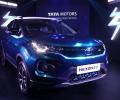
Tata Motors plans to have 10 new battery electric vehicles (BEVs) in its domestic product portfolio by 2025 as it looks to drive its business model towards sustainable mobility going ahead, as per Tata Motors chairman N Chandrasekaran. In his message to the shareholders, he noted that the auto major aims to be amongst the world leaders in sustainable mobility solutions and as part of that it is also exploring tie-ups in cell and battery manufacturing to secure supplies for its portfolio of green vehicles. "In India, EV penetration in our portfolio has now doubled to 2 per cent this year and we expect penetration to increase exponentially in the coming years. "Tata Motors will lead this change in the Indian market. By 2025, Tata Motors will have 10 new BEV vehicles and as a Group, we will invest proactively to set up charging infrastructure across the country," Chandrasekaran informed shareholders in the company's Annual Report for 2020-21.

koda Auto Volkswagen India is actively exploring various approaches to penetrate India's burgeoning electric vehicle (EV) market, including importing global models, local assembly, and developing highly localised products, as EV penetration is expected to reach 17-18% by the end of the decade.
Tata Motors' MD and CEO, Girish Wagh, has identified rising diesel prices as the most significant threat to India's commercial vehicle (CV) industry recovery, despite the sector recently surpassing its pre-FY19 wholesale peak. Diesel costs account for 25-50% of a truck operator's total cost of ownership, making any increase a critical concern for fleet economics.
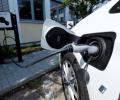
Tata Motors is planning to invest Rs 15,000 crore in the EV segment in the next five years, a top company official has said. The company, which is a leader in the newly emerging EV segment with offerings such as Nexon, is also planning to develop around 10 more new offerings in the segment, president for Passenger Vehicles Business of Tata Motors Shailesh Chandra said. "As far as future is concerned, in next five (years) we will invest Rs 15,000 crore in electrification.

The company took five years to sell the 250,000 units of the Nano.

With the theme 'Smart Mobility, Smart Cities', the company's display at the Auto Expo is focusing on intelligently-connected cities designed to offer convenience, safety, security, and efficiency to its customers.
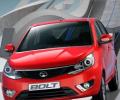
Both will be powered by the company's Revotron 1.2-litre turbo-charged petrol engines.

The company, which on Wednesday launched its compact sedan Zest in the NCR, priced between Rs 464,000 and Rs 699,000 (ex-showroom Delhi), is also working to upgrade its sales and service network.

With swanky showrooms and VR-enabled sales platforms Maruti Suzuki, Tata Motors, and Skoda bet on shine and gloss,and place their faith in experiential branding.

Volkswagen, a long-standing but minor player in India's fiercely competitive automotive sector, is now exploring a strategic partnership with the JSW group, aiming to revitalise its market presence, enhance profitability, and potentially establish India as a key export hub for electric vehicles.

India-EU FTA opens a bigger European market for Indian carmakers while giving European brands greater access to India.
Tata Motors on Thursday said its car sales in August 2003 grew by 23.5 per cent to nearly 11,700 units over 9,482 units sold in the same month last year.
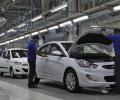
Indian carmakers experienced a robust start to the new fiscal year, with an estimated 4.5 lakh passenger vehicles sold in April, marking a 27 per cent increase year-on-year, attributed to factors like GST 2.0, repo rate cuts, and income tax benefits.

Tata Motors on Wednesday expanded its electric vehicle range in the country with the launch of Nexon EV MAX, priced between Rs 17.74-19.24 lakh (ex-showroom). Equipped with a 40.5 kWh lithium-ion battery pack, the Nexon EV Max offers 33 per cent higher battery capacity than the Nexon EV, delivering ARAI certified range of 437 km (under standard testing conditions), ensuring uninterrupted inter-city travel. ARAI refers to Automotive Research Association of India. The model produces 105 kW (143 PS) of power and delivers a torque of 250 Nm, resulting in 0 to 100 sprint times in under 9 seconds.

The new SUV from the Tatas will compete with the likes of Jeep Compass, Hyundai Creta, Hyundai Tucson and the Mahindra XUV500.

The automobile and auto-ancillary sector is expected to show strong Q3FY26 results, aided by festival-led demand, rationalisation in goods and services tax (GST) rates for select categories of vehicles, easing interest rates, and improving rural sentiment.

The company has delivered 1,000 cars to buyers and is in the process of delivering another 2,000 units.
The funds would be utilised to meet capital and product development expenses in projects involving the growth of both its commercial vehicle and passenger car business units apart from other unspecified corporate purposes.

RIL is also more profitable than Tata Motors.
The country's top automaker in terms of revenue plans to launch a total of 50 products in the CV segment during 2018-19.

Indian companies are increasingly opting for demergers, with 29 deals valued at over $40 billion in 2025 alone, marking a 10-year high, as promoters and boards recognise that markets favour focused businesses over complex conglomerates.

India's electric passenger vehicle market saw an 87.4 per cent year-on-year increase in FY26, reaching 233,246 units, primarily driven by the mid-size SUV segment (20-30 lakh price bracket), while the entry-level segment (sub-10 lakh) experienced a decline.

From the Sensex pack, Eternal, Bharat Electronics Ltd, Trent, Axis Bank, State Bank of India, Bajaj Finance, Sun Pharmaceuticals, Asian Paints, Adani Ports, Hindustan Unilever, Reliance Industries, ITC, PowerGrid, Tata Motors Ltd's Commercial Vehicles business, and Bajaj Finserv were the gainers. Infosys, Tata Motors Passenger Vehicles, Tata Steel, ICICI Bank, Tech Mahindra, Titan, UltraTech Cement, Maruti Suzuki India, and Larsen & Toubro were the laggards.

Code-named Pelican, bigger hatchback with new petrol and diesel engines may hit the road next year.

It has turned around its domestic operations under the HorizoNext strategy

The auto major had posted a profit of Rs 3,945.47 crore (Rs 39.45 billion) in the same period a year earlier.

Network scale seen as central to tapping smaller markets.
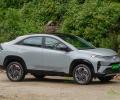
As battery prices drop, early customers of Tata Motors, which was the first mover in the passenger EV market, could feel let down.
